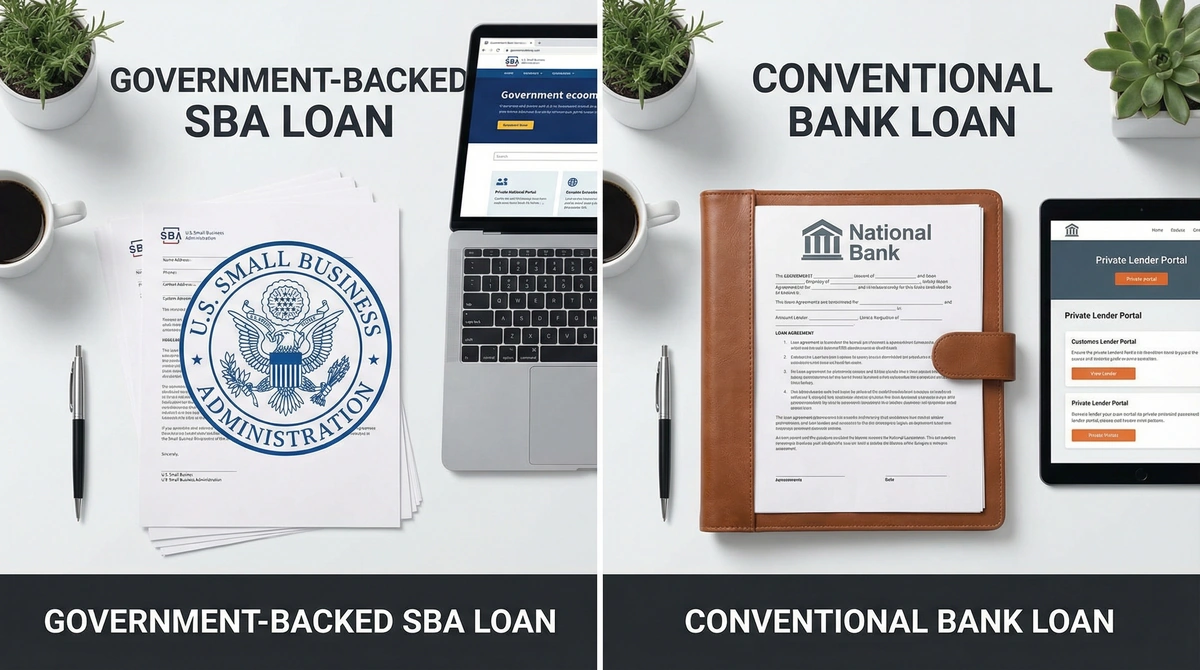
The short answer when comparing an SBA loan vs conventional loan: SBA loans are the better deal for most small business owners who can wait 30-90 days for funding. Conventional loans win when you need speed, have an established banking relationship, or don’t meet SBA eligibility requirements.
But the real answer depends on your specific situation — your credit, your timeline, how much you’re borrowing, and what you need the money for. This guide breaks down every factor so you can make the right call for your business.
How SBA Loans and Conventional Loans Differ
The fundamental difference comes down to risk sharing. With an SBA loan, the Small Business Administration guarantees 50-85% of the loan amount. If you default, the government covers that portion of the lender’s loss. This guarantee encourages lenders to offer terms they wouldn’t otherwise — lower rates, smaller down payments, and longer repayment periods.
With a conventional business loan, the lender takes on 100% of the risk. No government safety net. That means lenders protect themselves by charging higher rates, requiring more collateral, demanding larger down payments, and setting stricter qualification standards.
Key Takeaway
The SBA doesn’t lend money directly — it guarantees a portion of the loan made by a participating lender. That guarantee is what unlocks better terms for borrowers.
SBA Loan vs Conventional Loan: Side-by-Side Comparison
| Factor | SBA Loan | Conventional Loan |
|---|---|---|
| Interest Rate | Prime + 1.5% to 3% (SBA-capped) | Prime + 2% to 6%+ (lender sets) |
| Max Amount | $5,000,000 (7(a)) / $5,500,000 (504) | Varies by lender (no cap) |
| Down Payment | 10-20% | 20-30% |
| Repayment Terms | Up to 25 years (real estate) / 10 years (working capital) | Typically 3-10 years |
| Credit Score | 640+ (varies by lender) | 680+ (often higher) |
| Speed to Funding | 30-90 days (Express: 2-4 weeks) | 1-4 weeks |
| Collateral | Required but flexible (SBA won’t deny for lack of it) | Strictly required in most cases |
| Government Guarantee | 50-85% guaranteed by SBA | None |
| Extra Fees | SBA guarantee fee (0-3.75%) | No government fees |
Interest Rates and How They’re Set
One of the biggest advantages of SBA loans is the rate cap. The SBA sets maximum interest rates that lenders can charge on 7(a) loans — typically Prime + 1.5% to 3%, depending on the loan size and term. This protects borrowers from excessive markups and keeps rates competitive even if your financial profile isn’t perfect.
Conventional lenders have no such cap. They set rates based entirely on their own risk assessment. For strong borrowers with excellent credit and substantial collateral, conventional rates can be competitive. But for the average small business owner, conventional rates often run 2-4 percentage points higher than what an SBA loan would cost.
Pro Tip
SBA rate caps protect borrowers from lender markups. Even if your credit isn’t pristine, the maximum rate you’ll pay on a 7(a) loan is capped — something conventional lenders never guarantee. Learn more about how SBA loan interest rates are calculated.
Down Payment and Collateral Requirements
Down payment requirements often determine whether a deal is feasible. Here’s how the two options compare:
- ✓SBA loans typically require 10-20% down. The SBA guarantee reduces the lender’s exposure, so they’re comfortable with less borrower equity. Collateral is required but the SBA explicitly states that lenders should not deny a loan solely due to insufficient collateral.
- ✓Conventional loans typically require 20-30% down — sometimes more for newer businesses. Collateral requirements are stricter because the lender bears 100% of the risk. Insufficient collateral is a common reason for conventional loan denial.
For a $500,000 project, the difference between 10% down (SBA) and 25% down (conventional) is $75,000 out of your pocket. That’s a significant gap that can make or break a deal.
Approval Requirements Compared
Both options evaluate your creditworthiness, but the standards differ significantly:
| Requirement | SBA Loan | Conventional Loan |
|---|---|---|
| Credit Score | 640+ (no SBA-mandated minimum) | 680+ (often 700+ for best terms) |
| Time in Business | No minimum (but 2+ years helps) | Typically 2+ years required |
| Revenue | Must demonstrate ability to repay | Often requires minimum revenue thresholds |
| Documentation | Extensive (business plan, projections, tax returns) | Less paperwork but stricter financial standards |
Important Difference
Conventional lenders can reject you for any reason — there are no standardized approval criteria. SBA guidelines provide a more consistent framework, which means your application is evaluated more predictably. To prepare your financial documents, review the SBA loan requirements lenders look for.
Speed and Timeline
This is where conventional loans have a clear advantage. If you have an existing banking relationship, a conventional business loan can close in 1-2 weeks. SBA 7(a) loans typically take 30-90 days because of the additional SBA review layer. SBA Express loans are faster — the SBA responds within 36 hours — but the total process from application to funding still runs 2-4 weeks.
If you need capital urgently — for example, to close on a time-sensitive acquisition — a conventional loan or SBA Express may be your best option. For everything else, the 30-90 day SBA timeline is worth the wait for the better terms.
Fees and Total Cost of Borrowing
SBA loans come with a guarantee fee that conventional loans don’t — ranging from 0% to 3.75% of the guaranteed portion, depending on the loan amount and maturity. On a $500,000 loan, that could mean an upfront fee of $10,000 to $15,000. Both loan types carry closing costs (typically 2-5% of the loan amount), so that expense is roughly comparable.
The Math Matters
Despite the guarantee fee, the total cost of an SBA loan is often lower than a conventional loan when you factor in the lower interest rate and longer repayment term. A 2% lower rate over 10 years saves far more than a one-time 3% fee. Check our guide on SBA loan closing costs for a full breakdown.
Which One Should You Choose?
The right choice depends on your situation. Here’s a quick decision framework:
Choose an SBA Loan If…
You want the lowest possible rate and longest repayment terms. You can wait 30-90 days for funding. You have limited collateral or a smaller down payment. Your business is newer (under 2 years). You want the SBA’s rate cap protection. This is the right path for most small business owners.
Choose a Conventional Loan If…
You need funds within 1-2 weeks. You have an established banking relationship with favorable terms already negotiated. Your credit is excellent (720+) and you have substantial collateral. You want to avoid the SBA guarantee fee and extra paperwork. You need a loan amount above $5,000,000.
Consider Both If…
You need fast working capital now (conventional line of credit) plus long-term financing for a major purchase (SBA 7(a) or 504). Many business owners use both types strategically for different needs. A conventional line of credit for day-to-day cash flow and an SBA loan for the big investments can be a powerful combination.
Make the Right Financing Decision
When weighing an SBA loan vs conventional loan, the numbers usually favor the SBA route — lower rates, longer terms, and smaller down payments add up to significant savings over the life of the loan. The tradeoff is a longer approval process and additional paperwork.
The best approach is to talk to a lender experienced in both options. They can run the numbers for your specific situation and show you exactly what each path looks like. You don’t have to guess — the right answer is in the math.
Not Sure Which Loan Is Right for You?
Our financing team can compare SBA and conventional options for your specific situation — no obligation, no pressure. Let us show you the numbers so you can decide with confidence.